


22 Oct 2026
From Megawatts to Mindshare: The True Cost of Producing Intelligence

Author
Admin
Most of us have heard the headlines: AI is hungry. Tools like ChatGPT and other generative models require substantial electricity to train and to run at scale. But “AI uses energy” doesn’t really explain the more interesting question: why producing a single good answer can feel so expensive in physical terms.
That’s because every response begins far away from the screen in your hand. It starts at generation, moves through transmission networks, reaches a data center, is conditioned and cooled, converted and distributed again inside the facility, and finally becomes computation inside silicon. The result we experience as “intelligence” is what’s left at the end of that journey.
In that sense, artificial intelligence has something in common with biological intelligence. A human mind doesn’t run directly on breakfast. It runs on a long chain of conversion, transport, regulation, and loss—digestion, circulation, respiration, metabolism—before anything becomes thought. Intelligence isn’t the input. Intelligence is the output of a system.
To understand the true cost of AI, it helps to think less about a model as a standalone “mind,” and more about the body that keeps it alive.
The Leaky Funnel
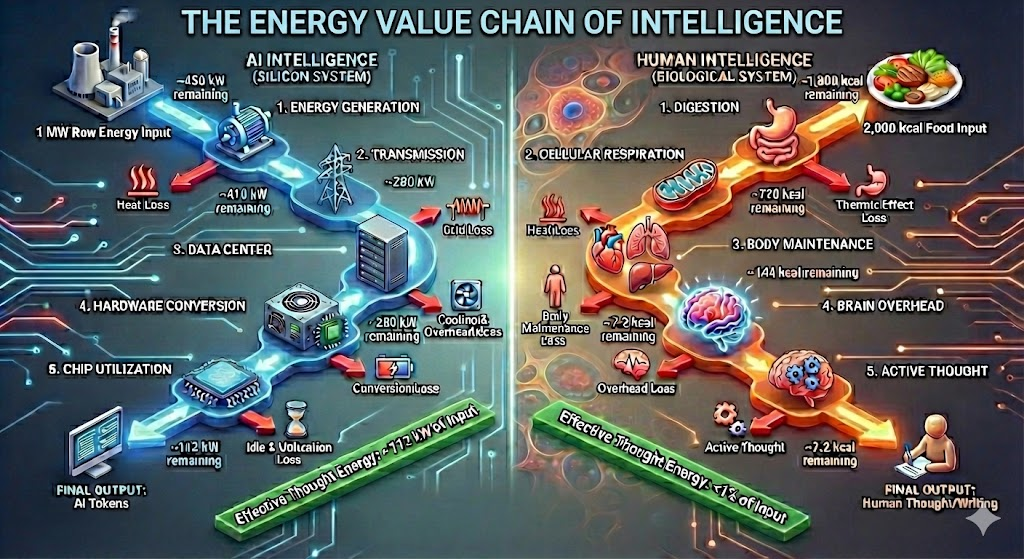
As the graphic illustrates, both biology and computing behave like leaky funnels. We pour high-potential energy into the top, and we pay a “tax” at every stage as that energy is converted, moved, and managed.
In the silicon world, energy is lost at generation and across transmission. Once power arrives at a data center, more energy is spent conditioning the environment – cooling, airflow control, pumping, and the supporting systems needed to run reliably. Then, inside the IT stack, there are further inefficiencies: power conversion, distribution losses, and the unavoidable reality that even very advanced chips spend time waiting on other components in the system. Only at the very end does energy become the moment we value: a token, an inference, a prediction, a useful response.
The biological world is no different. The body expends energy just to maintain the baseline: temperature regulation, circulation, respiration, and the essential work of staying alive. The brain is remarkably efficient, but it still relies on a vast supporting system to do its job. The “thinking” we notice is the tip of an iceberg supported by metabolism.
The point isn’t that either system is wasteful by accident. The point is that intelligence is downstream of infrastructure.
Why Anatomy Matters to Industry
So why should business leaders care about the thermodynamics of a neuron or a microchip?
Because it reframes where the constraints are likely to appear next.
For the last few years, the world has been captivated by the “mind”: large language models, algorithms, software breakthroughs. And those matter. But the anatomy analogy reminds us that a brilliant mind cannot outperform the body that sustains it. If the physical system is constrained by power availability, by grid capacity, by cooling limits, by poor efficiency, or by reliability shortfalls, then the potential of AI is constrained, too.
This is where the conversation shifts from novelty to industrial reality. As AI adoption accelerates, the limiting factor often stops being “can we build the model?” and becomes “can we deliver the compute reliably, efficiently, and at scale?”
In that world, the strategic advantage moves toward the physical value chain:
- resilient power delivery and predictable expansion paths
- data centers engineered for high-density reality, not yesterday’s assumptions
- cooling approaches that are designed, operated, and maintained with discipline
- commissioning rigor and operational readiness that keeps performance stable under load
In other words: the next chapter of AI is as much an infrastructure story as it is a software story.
From separate parts to a single system
One of the biggest mistakes we can make is treating this value chain as a set of disconnected components: generation over here, transmission over there, data centers somewhere else, chips and software in a separate conversation altogether.
The more productive way to think about the future is as a single, flowing ecosystem. G42 describes this kind of end-to-end view as an “Intelligence Grid”, a model where optimizing AI’s “metabolism” means aligning the whole chain: cleaner power at the source, efficient delivery across networks, high-performance facilities that reduce waste, and systems engineered to turn watts into useful work more predictably.
Whether you use that label or not, the direction is clear. We can’t meet the next wave of AI demand simply by pushing more energy into an inefficient funnel. We have to improve the funnel.
What this means in practice for AI infrastructure
If you accept the “leaky funnel” reality, the goal becomes straightforward: reduce the taxes along the chain and improve the conversion of energy into useful computation.
That doesn’t come from one silver bullet. It comes from engineering and operating discipline. That means design choices that are validated through commissioning, and operational practices that sustain performance over time.
This is where wholesale operators play a defining role. Not by competing with customers on model-building or chip design, but by doing the essential work of the “body”: delivering environments that are ready to run – power-and-cooling capable, safely operated, resilient, and repeatable at scale.
The real cost of intelligence, and the real opportunity
The cost of producing intelligence is not just an electricity bill. It’s the cumulative cost of losses, constraints, and complexity across a physical value chain. And the opportunity is equally physical: every improvement in efficiency, readiness, and reliability increases what AI can do, without simply scaling energy input linearly.
As we build the infrastructure that will define the next decade, the ambition should be simple: ensure every watt travels a cleaner, more efficient, more predictable path – from megawatts at the source to mindshare on the screen.